
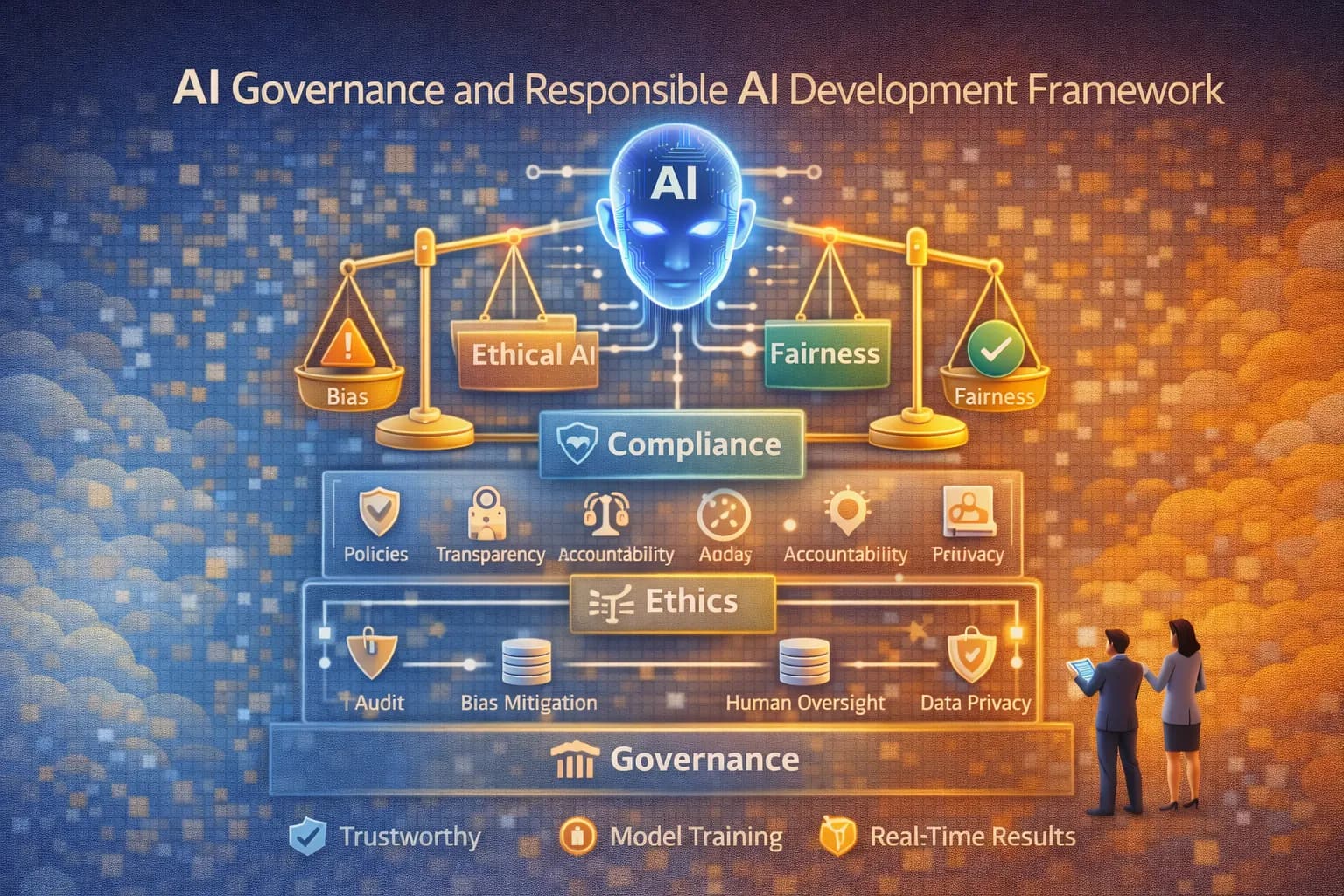
AI Governance, Ethics, and Responsible AI Development
Md Sharif Foysal Shoron
Author
Artificial intelligence is no longer limited to experimental use cases or internal optimizations. Today, AI systems influence customer experiences, financial decisions, hiring processes, content moderation, and operational strategy. As AI becomes deeply embedded in business operations, questions around governance, ethics, and responsibility become unavoidable.
Responsible AI development ensures that intelligent systems operate fairly, transparently, and safely. Without governance frameworks, AI can unintentionally introduce bias, create legal exposure, and erode user trust. Businesses that treat governance as an afterthought often face long-term risks that outweigh short-term gains.
What AI Governance Really Means
AI governance refers to the policies, processes, and controls that guide how AI systems are designed, deployed, monitored, and improved. It defines who is accountable for AI decisions, how models are evaluated, and how risks are mitigated.
Governance is not about limiting innovation. It is about ensuring AI systems align with organizational values, legal requirements, and societal expectations. Well-governed AI enables confidence, scalability, and long-term adoption.
Ethical Risks in AI Systems
AI systems learn from historical data, which may contain bias, imbalance, or flawed assumptions. Without careful oversight, these issues can be amplified by machine learning models.
Common ethical risks include biased decision-making, lack of transparency, misuse of personal data, and unintended discrimination. These risks can affect customers, employees, and stakeholders in significant ways.
Fairness and Bias Mitigation
Fairness in AI requires intentional design and continuous evaluation. Businesses must assess whether models produce consistent outcomes across different user groups.
Bias mitigation techniques include balanced datasets, model audits, and regular performance reviews. Fair AI systems improve trust and reduce regulatory risk.
Transparency and Explainability
Users and regulators increasingly expect transparency in AI-driven decisions. Explainable AI provides insight into how and why a system reached a specific outcome.
Transparency does not require exposing proprietary algorithms. Instead, it focuses on providing meaningful explanations that build confidence and accountability.
Data Privacy and Compliance
AI systems often process sensitive personal and business data. Responsible AI development requires strict adherence to privacy regulations such as GDPR and industry-specific standards.
Strong access control, data minimization, and audit logging are essential components of compliant AI systems.
Human Oversight and Accountability
AI should support human decision-making, not replace accountability. Clear ownership ensures that AI-driven outcomes can be reviewed, challenged, and corrected.
Human-in-the-loop approaches provide safeguards for high-impact decisions, balancing automation with judgment.
Building Governance into AI Architecture
Governance should be embedded into system architecture from the beginning. This includes logging, version control, access management, and performance monitoring.
Backend frameworks like Django support responsible AI by enabling secure APIs, permission systems, and audit trails.
Long-Term Business Value of Responsible AI
Ethical and well-governed AI systems reduce risk, improve trust, and support sustainable growth. Businesses that invest in responsible AI are better positioned to scale confidently.
How Square Tech IT Approaches Responsible AI
At Square Tech IT, we design AI systems with governance, ethics, and accountability at their core. Our approach ensures AI solutions are secure, compliant, and aligned with long-term business values rather than short-term experimentation.