
AI in Digital Marketing: Smarter Campaigns Through Automation
Md Sharif Foysal Shoron
Author
Digital marketing has evolved rapidly over the past decade. What once relied heavily on manual planning, static campaigns, and intuition is now driven by data, automation, and intelligent systems. As marketing channels multiply and customer expectations rise, traditional marketing approaches struggle to deliver consistent results at scale. Artificial intelligence is changing this landscape by enabling smarter, faster, and more adaptive marketing strategies.
AI-powered digital marketing does not replace creativity or strategy. Instead, it enhances them by automating repetitive tasks, analyzing vast datasets, and uncovering insights that would be impossible to detect manually. This allows marketing teams to focus on strategy and storytelling while AI handles optimization and execution.
The Challenges of Traditional Digital Marketing
Traditional digital marketing relies on predefined segments, fixed schedules, and manual performance analysis. While effective in simpler environments, this approach struggles with modern complexity. Audiences behave differently across platforms, engagement patterns change quickly, and competition for attention is intense.
Marketers often face delays between campaign execution and performance analysis. By the time insights are available, opportunities may already be lost. This lag limits agility and reduces the effectiveness of marketing investments.
How AI Transforms Digital Marketing
AI introduces real-time intelligence into marketing operations. Machine learning models analyze user behavior, campaign performance, and contextual data continuously, enabling dynamic adjustments without manual intervention.
Instead of running static campaigns, AI-driven systems adapt messaging, timing, and channel selection automatically. This ensures that marketing efforts remain relevant as conditions change.
Audience Segmentation and Personalization
One of the most powerful applications of AI in digital marketing is advanced audience segmentation. AI models analyze behavior, demographics, and engagement patterns to create dynamic segments that evolve over time.
Personalization goes beyond inserting a user’s name into an email. AI tailors content, recommendations, and offers based on individual preferences and real-time behavior, significantly improving engagement and conversion rates.
Automated Campaign Optimization
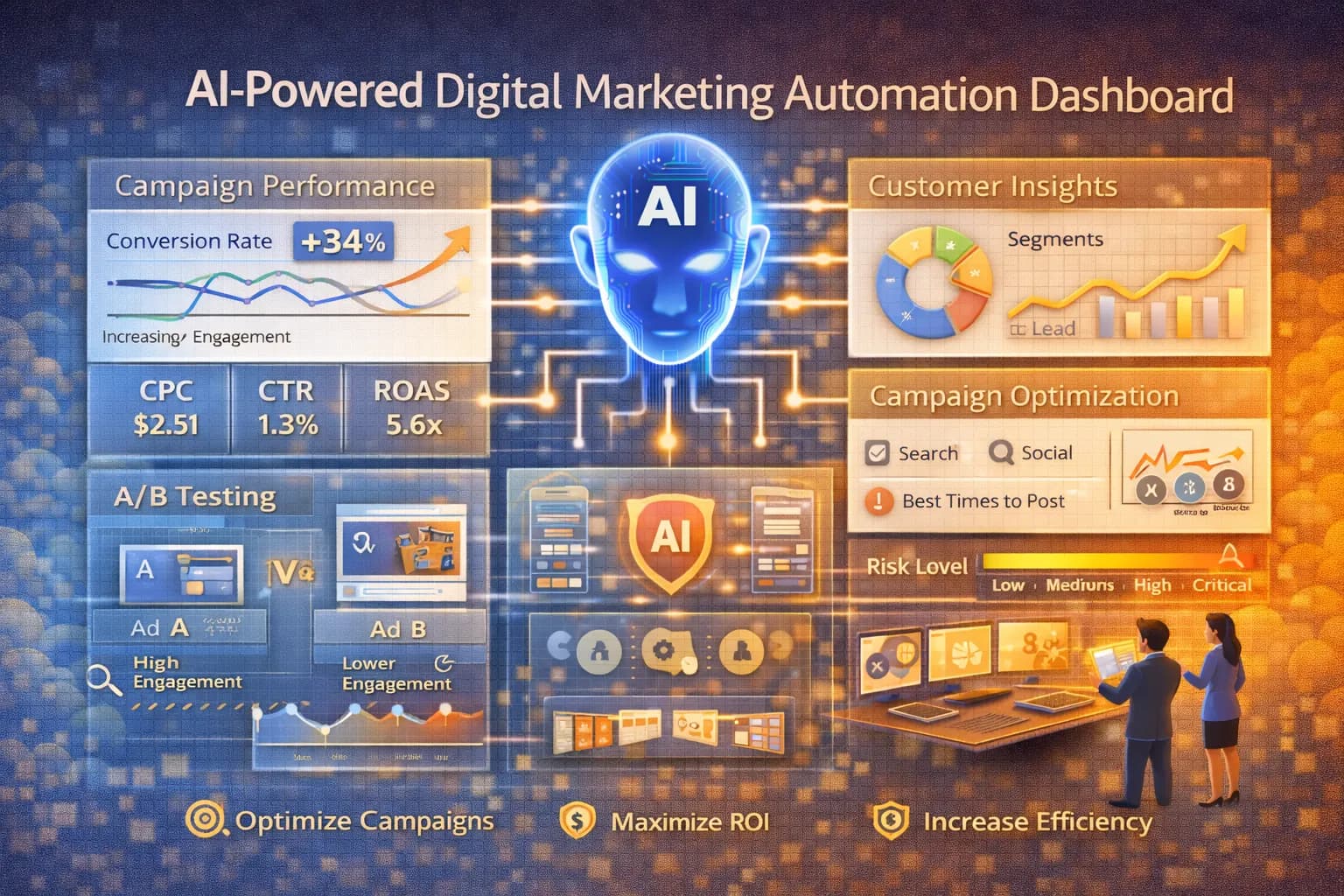
AI continuously monitors campaign performance across channels such as search, social media, email, and display advertising. Based on performance signals, AI systems adjust bids, budgets, and creative elements automatically.
This automation reduces wasted spend and maximizes return on investment by allocating resources where they perform best.
Content Creation and Optimization
AI assists marketers in content ideation, optimization, and distribution. By analyzing audience engagement data, AI identifies which topics, formats, and headlines resonate most effectively.
While AI does not replace human creativity, it provides data-driven guidance that improves content relevance and performance.
Email Marketing and Marketing Automation
AI-driven email marketing platforms optimize send times, subject lines, and content based on user behavior. Automated workflows adapt as users interact with campaigns, ensuring timely and relevant communication.
These systems increase open rates, click-through rates, and long-term engagement while reducing manual effort.
Predictive Analytics in Marketing
Predictive analytics allows marketers to anticipate future outcomes such as customer churn, lifetime value, or purchase intent. AI models analyze historical data to forecast behavior and guide proactive strategies.
Data Integration and Backend Support
Effective AI marketing systems require strong backend infrastructure. Data from websites, CRMs, analytics platforms, and advertising tools must be collected, validated, and processed securely.
Backend frameworks like Django support these systems through secure APIs, data pipelines, and role-based access control.
Ethical Considerations and Trust
Responsible AI marketing respects user privacy, consent, and transparency. Ethical data usage builds long-term trust and protects brand reputation.
The Business Impact of AI Marketing Automation
AI-driven marketing increases efficiency, improves targeting accuracy, and delivers measurable performance gains. Over time, these systems enable scalable growth without proportional increases in cost.
How Square Tech IT Builds AI Marketing Solutions
At Square Tech IT, we design AI-powered digital marketing systems that combine automation, analytics, and personalization. Our solutions help businesses run smarter campaigns, improve ROI, and adapt quickly in competitive markets.