
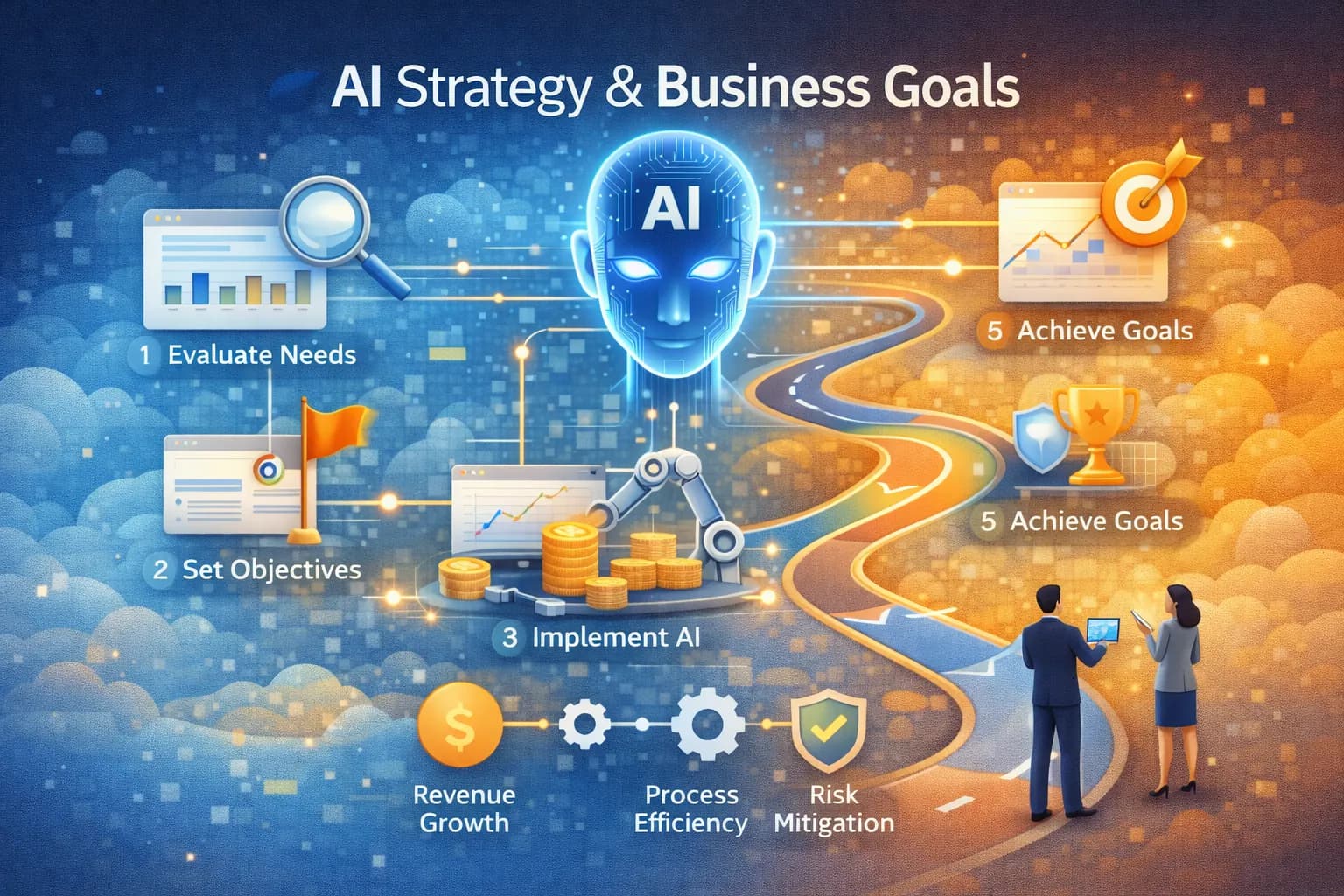
Building an AI Strategy Aligned with Business Goals
Md Sharif Foysal Shoron
Author
Artificial intelligence delivers the greatest value when it is guided by clear business objectives rather than technical curiosity. Many organizations invest in AI because it is trending, only to discover that their systems fail to deliver meaningful outcomes. A successful AI strategy starts with understanding what the business actually needs to achieve.
Aligning AI initiatives with business goals ensures that investments translate into measurable improvements such as cost reduction, operational efficiency, better customer experiences, or improved decision-making. Without alignment, AI becomes an expensive experiment rather than a strategic asset.
Why Business Alignment Is Critical for AI Success
AI systems are powerful, but they are not inherently valuable. Their value depends entirely on how well they support business priorities. When AI projects are disconnected from strategy, teams struggle to define success and justify continued investment.
Alignment creates clarity. It ensures stakeholders understand why AI is being implemented and what outcomes are expected. This clarity simplifies decision-making, prioritization, and performance evaluation.
Defining Clear Business Objectives
The first step in building an AI strategy is identifying the specific problems AI should solve. These problems should be measurable and directly tied to business performance.
Examples include reducing operational costs, improving forecasting accuracy, automating repetitive workflows, or enhancing customer engagement. Clear objectives help teams determine whether AI is necessary or if simpler solutions are sufficient.
Assessing Data Readiness
AI strategies fail when data foundations are weak. Before investing in AI models, businesses must evaluate data availability, quality, and consistency.
Clean, well-structured data enables reliable training and accurate predictions. Without it, AI systems produce unstable results that undermine trust and adoption.
Choosing the Right AI Use Cases
Not every business problem requires AI. The most effective AI strategies focus on use cases where learning, prediction, or pattern recognition provides a clear advantage over rule-based automation.
Starting with small, high-impact use cases allows teams to validate value before expanding AI capabilities across the organization.
Integrating AI into Existing Systems
AI systems deliver the most value when integrated into existing workflows, dashboards, and backend systems. Isolated AI tools often fail due to poor adoption.
Backend frameworks like Django provide a strong foundation for integrating AI into scalable, secure systems through APIs and data pipelines.
Measuring Success and Iterating
AI strategies must include performance metrics tied to business outcomes. Continuous monitoring ensures models remain accurate and aligned with evolving goals.
How Square Tech IT Builds Business-Aligned AI Strategies
At Square Tech IT, we design AI strategies that start with business goals and end with measurable results. Our approach ensures AI systems remain practical, scalable, and aligned with long-term growth.