
AI vs Automation: Understanding the Difference and Business Impact
Md Sharif Foysal Shoron
Author
Artificial intelligence and automation are frequently used interchangeably, but they are not the same. While both aim to improve efficiency and reduce manual effort, they solve different problems and deliver value in distinct ways. Understanding this distinction is essential for businesses that want to invest wisely in technology rather than adding unnecessary complexity.
Many organizations assume that adopting AI automatically means automation, or that automation requires AI. In reality, these technologies serve different purposes and are often most effective when applied together in the right context. Understanding the difference between AI and automation helps businesses choose the right approach, set realistic expectations, and avoid costly implementation mistakes.
What Automation Really Is
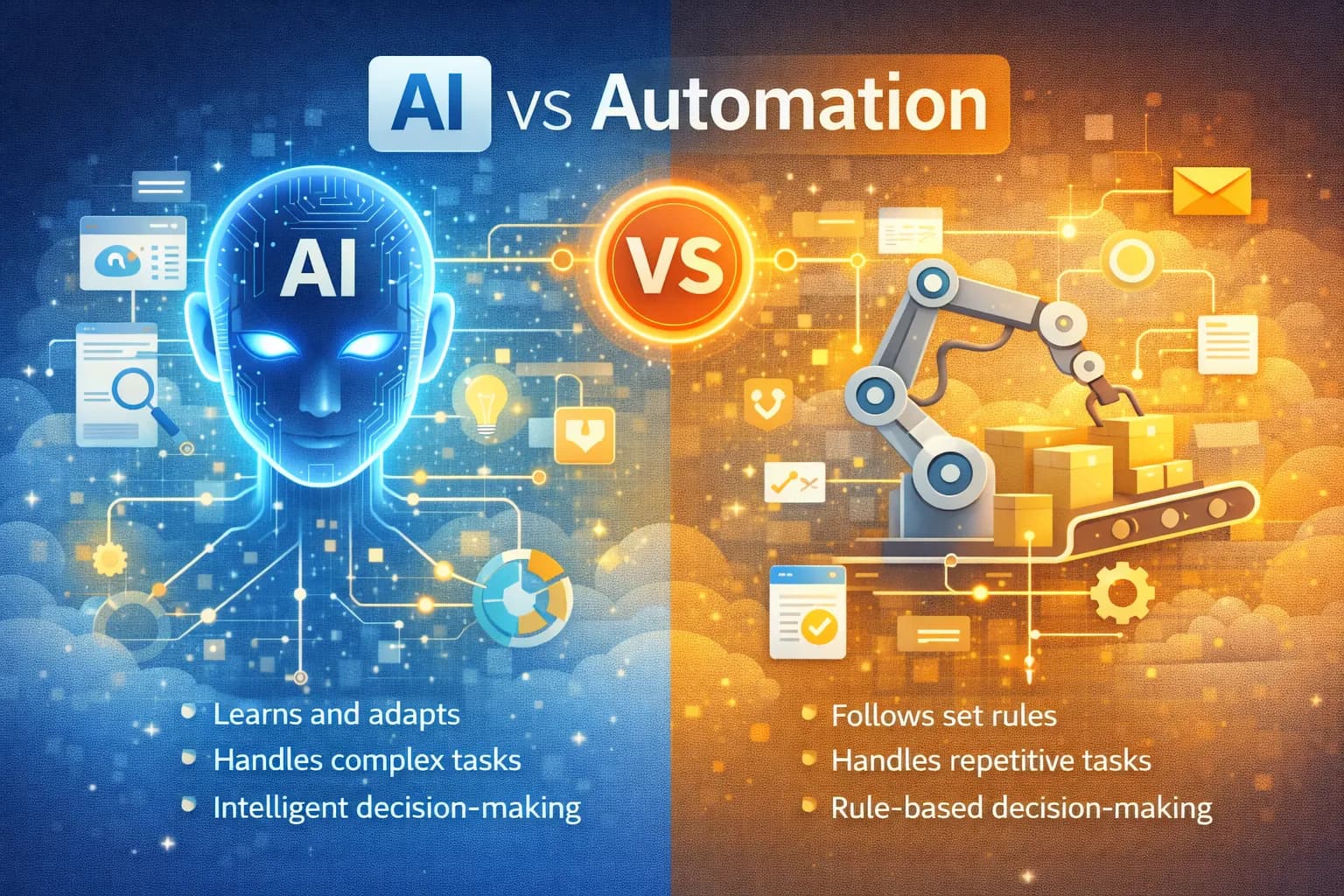
Automation focuses on executing predefined tasks without human intervention. These systems follow fixed rules and workflows designed by humans and operate exactly as instructed. Automation does not learn, adapt, or make decisions beyond what has been explicitly programmed.
Businesses commonly use automation to eliminate repetitive manual work, reduce errors, and improve operational consistency. When processes are predictable and well-defined, automation provides fast and reliable results with minimal maintenance.
Rule-Based Processes
Automated systems perform repetitive actions such as data transfers, scheduled reporting, billing generation, notifications, and system monitoring with high consistency. These processes rely on clear rules and conditions rather than interpretation or prediction.
For example, an automated billing system generates invoices based on predefined rules, while a monitoring system sends alerts when specific thresholds are crossed. These systems are efficient, cost-effective, and easy to maintain because their behavior is predictable.
What Makes AI Different
Artificial intelligence introduces adaptability and learning into systems. Unlike automation, AI systems analyze data, identify patterns, and improve their performance over time. AI is designed to handle uncertainty, variation, and complex decision-making scenarios.
AI systems are particularly useful when rules cannot be clearly defined in advance or when outcomes depend on changing data. Instead of following fixed instructions, AI models make informed decisions based on historical and real-time information.
Learning and Adaptation
Machine learning models analyze patterns in data and adjust their outputs as new information becomes available. This allows AI systems to adapt to changing conditions, improve accuracy, and handle scenarios that traditional automation cannot manage.
Examples include fraud detection systems that learn new attack patterns, recommendation engines that adapt to user behavior, and demand forecasting models that adjust predictions based on market trends.
Business Use Cases for Automation
Automation is ideal for structured, repetitive tasks that follow clear and consistent rules. Common use cases include billing, payroll processing, report generation, system monitoring, email notifications, and workflow orchestration.
These tasks benefit from automation because they reduce manual effort, minimize errors, and ensure predictable outcomes. Automation delivers immediate value with relatively low complexity, making it an excellent first step for digital transformation.
Business Use Cases for AI
AI excels in areas that require pattern recognition, prediction, classification, and personalization. Use cases include fraud detection, customer behavior analysis, demand forecasting, recommendation systems, and intelligent search.
These scenarios involve complexity and variability that cannot be handled effectively with simple rules. AI enables systems to respond intelligently to changing data and evolving conditions.
Combining AI and Automation
The most effective digital systems combine AI with automation. In this hybrid approach, AI handles decision-making and insights, while automation executes actions at scale. This combination allows businesses to build intelligent workflows that operate efficiently and adapt over time.
For example, an AI model may identify high-risk transactions, while an automated system triggers alerts, blocks suspicious activity, or escalates cases for review. Together, AI and automation create powerful, scalable solutions.
Choosing the Right Approach
Choosing between AI, automation, or a hybrid approach depends on business goals, data availability, and system complexity. Not every problem requires AI, and overengineering solutions can increase cost and risk without added benefit.
At Square Tech IT, we help businesses evaluate their processes and determine whether automation, AI, or a combined approach best fits their goals, infrastructure, and long-term strategy. By applying the right technology to the right problem, businesses can achieve sustainable efficiency and growth.