
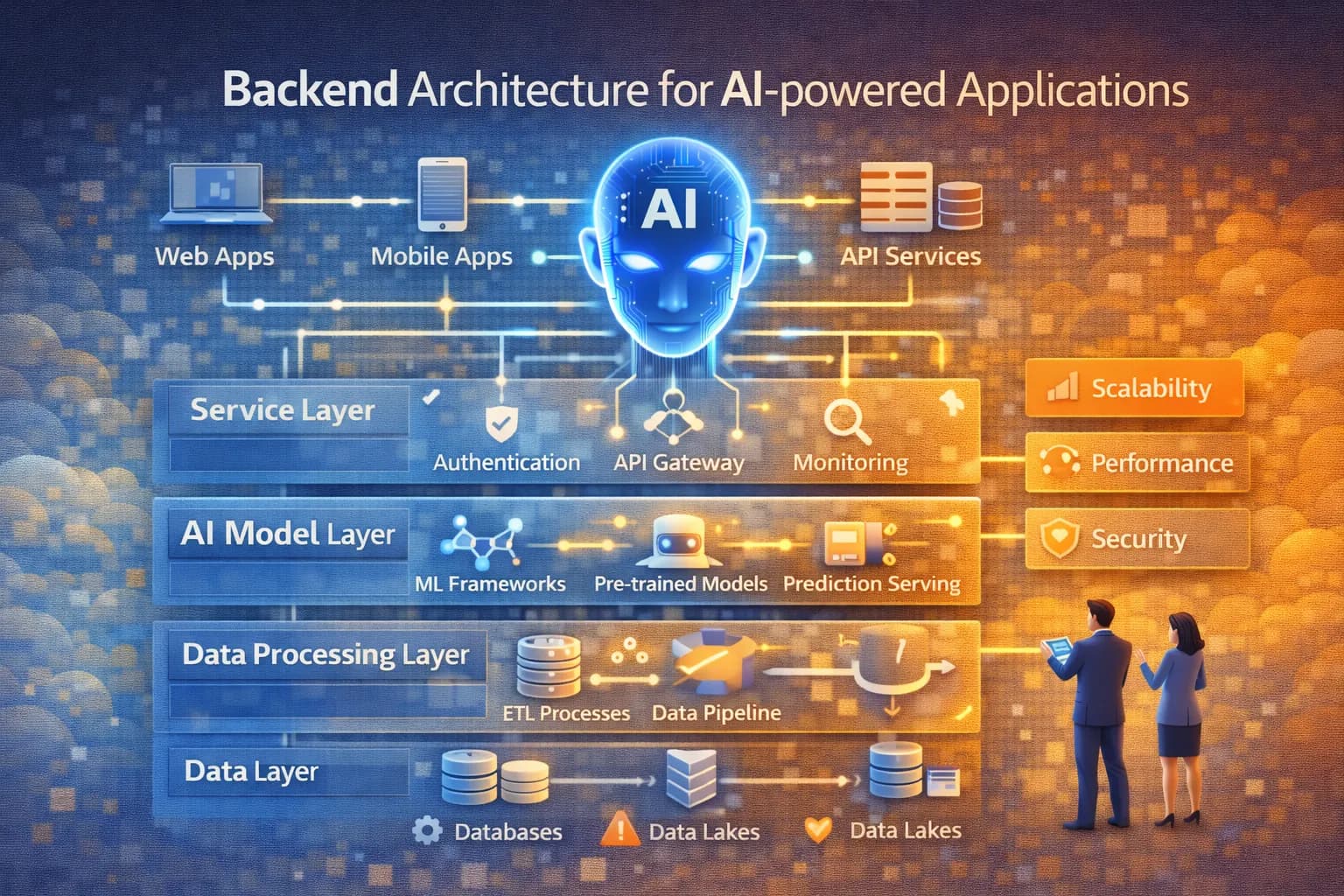
Designing Backend Architecture for AI Applications
Md Sharif Foysal Shoron
Author
Backend architecture plays a critical role in the success of AI-powered applications. While machine learning models often receive the most attention, they represent only a small part of the overall system. Without a well-designed backend, AI applications struggle with scalability, performance, reliability, and security.
AI applications introduce unique architectural requirements, including data pipelines, model inference services, monitoring systems, and continuous improvement workflows. Designing backend architecture with these needs in mind ensures AI systems remain stable and adaptable as usage grows.
Core Responsibilities of AI Backend Architecture
The backend of an AI application manages data ingestion, model execution, business logic, and system integration. Each responsibility must be clearly defined to avoid complexity and technical debt.
Data Pipelines and Storage
AI systems rely on continuous data ingestion from multiple sources. Backend architecture must support secure, scalable pipelines that collect, validate, and store data efficiently.
Databases, message queues, and background workers play a key role in ensuring data flows reliably through the system.
Model Training and Inference Separation
Training AI models and serving predictions are distinct processes. Backend architecture should separate these concerns to improve scalability and maintainability.
Inference services must remain responsive, while training workflows can run asynchronously without affecting user-facing systems.
API Design for AI Applications
APIs act as the interface between AI components and other systems. Clean, predictable APIs enable frontends, dashboards, and third-party services to consume AI insights safely.
Backend frameworks like Django support secure API development with authentication, permissions, and validation built in.
Scalability and Performance Optimization
AI inference can be computationally expensive. Backend architecture must support caching, asynchronous processing, and horizontal scaling to maintain performance.
Monitoring, Logging, and Reliability
AI systems require continuous monitoring to detect performance issues, errors, and model drift. Backend logging and observability tools provide visibility into system behavior.
Security and Compliance Considerations
AI backends handle sensitive data and decision logic. Strong access control, encryption, and audit logging are essential to maintain trust and regulatory compliance.
Supporting Continuous Improvement
AI systems improve over time through retraining and evaluation. Backend architecture must support iterative updates without disrupting production services.
Long-Term Maintainability
Clean separation of concerns, modular design, and clear documentation ensure AI backends remain maintainable as teams and requirements evolve.
How Square Tech IT Designs AI Backend Architecture
At Square Tech IT, we design backend architectures that support AI applications from prototype to enterprise scale. Our systems prioritize reliability, scalability, and security, ensuring AI capabilities deliver long-term business value.