
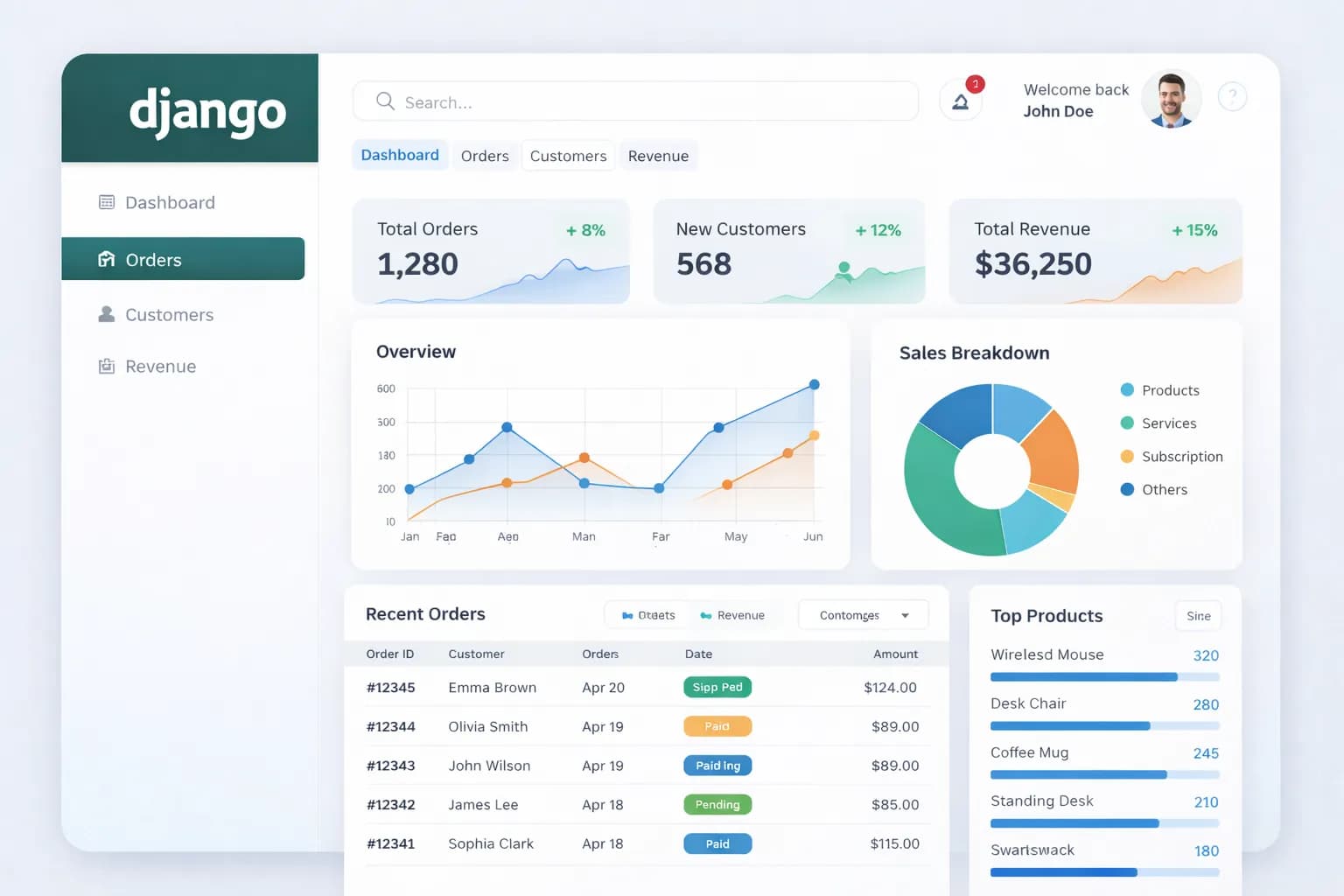
How to Build a Scalable Admin Dashboard Using Django (Step-by-Step Guide)
Md Sharif Foysal Shoron
Author
Admin dashboards are the backbone of modern web applications. They serve as the central control hub where businesses manage users, monitor operations, oversee content, track performance, and make critical decisions. A well-built dashboard does more than display data. It simplifies complex processes, improves efficiency, and enables teams to work with clarity and confidence.
As applications grow in complexity, the importance of a reliable and scalable admin dashboard becomes even more critical. Poorly designed dashboards can slow teams down, increase errors, and create operational bottlenecks. On the other hand, a thoughtfully designed dashboard becomes a powerful productivity tool that supports business growth.
Why Django Is an Excellent Choice for Admin Dashboards
Django is an excellent choice for building admin dashboards because it offers a strong foundation right out of the box. It is designed with security, scalability, and maintainability in mind, making it suitable for both small projects and enterprise-level applications.
Django’s structured architecture encourages clean code, predictable behavior, and long-term sustainability, which are critical for admin systems that evolve over time.
Designing Clear and Meaningful Data Models
The first and most important step in building a scalable dashboard is designing clear and meaningful data models. Before writing any interface code, it is essential to understand real business workflows.
This includes defining users, roles, permissions, and core business entities in a way that accurately reflects how the organization operates.
Using Django ORM for Flexible Data Modeling
Django’s ORM makes this process both powerful and flexible. Models can evolve over time as requirements change without requiring major rewrites. Relationships between entities can be clearly defined, ensuring data integrity and logical consistency.
When models are well-designed, the rest of the system becomes significantly easier to build, extend, and maintain.
Building Secure and Scalable APIs with Django REST Framework
Once the data models are in place, the next step is exposing clean and secure APIs using Django REST Framework. APIs act as the bridge between the backend and the frontend, enabling flexible and scalable user interfaces.
Well-designed endpoints should be focused, predictable, and easy to understand. Each endpoint should serve a clear purpose and return only the data required for that specific use case.
Role-Based Permissions and Access Control
Permission-aware APIs are especially important for admin dashboards. Different users often have different access levels, and Django REST Framework makes it easy to enforce role-based permissions.
This ensures that sensitive actions and data are only accessible to authorized users, reducing security risks and improving overall system reliability.
Backend Validation for Data Integrity
Validation should always live in the backend. While frontend validation improves user experience, it should never be the only line of defense.
Django’s form and serializer validation systems ensure that data entering the system meets defined rules and constraints. This protects data integrity and prevents invalid or malicious input from causing unexpected behavior.
By handling validation on the server side, the frontend can focus on usability and feedback rather than enforcing complex business rules. Clear error messages returned from the backend guide users toward correcting mistakes without confusion.
User Experience as the Final Layer of Success
User experience is the most visible layer of a successful admin dashboard. Even the most powerful backend will fail if users find the interface confusing or overwhelming.
Good UX starts with grouping related actions and information logically. Pages should present only what users need at a given moment, avoiding clutter and unnecessary options.
Clear Status Indicators and Consistent Layouts
Clear status indicators help users understand system state at a glance. Whether something is active, pending, published, or completed should always be obvious.
Consistent layouts, predictable interactions, and intuitive navigation reduce cognitive load and make dashboards easier to use.
Performance and Scalability Considerations
Performance plays a critical role in admin dashboard usability. Dashboards are often used daily and sometimes for extended periods. Fast response times and smooth interactions directly impact productivity.
Django’s efficient query handling and scalable architecture help ensure consistent performance as data volume and system complexity increase.
Scalability is not only about handling more users or data. It also means the ability to add new modules, workflows, and features without disrupting existing functionality. Django’s modular design supports gradual, stable growth.
How Square Tech IT Builds Reliable Django Dashboards
At Square Tech IT, we build scalable Django dashboards that grow alongside businesses. Our approach combines strong backend architecture with intuitive frontend design, ensuring dashboards remain secure, performant, and easy to use as requirements evolve.
A well-designed Django admin dashboard is not just an internal tool. It is a strategic asset that supports decision-making, improves efficiency, and enables sustainable growth. With the right architecture and UX from the beginning, dashboards remain effective for years to come.