
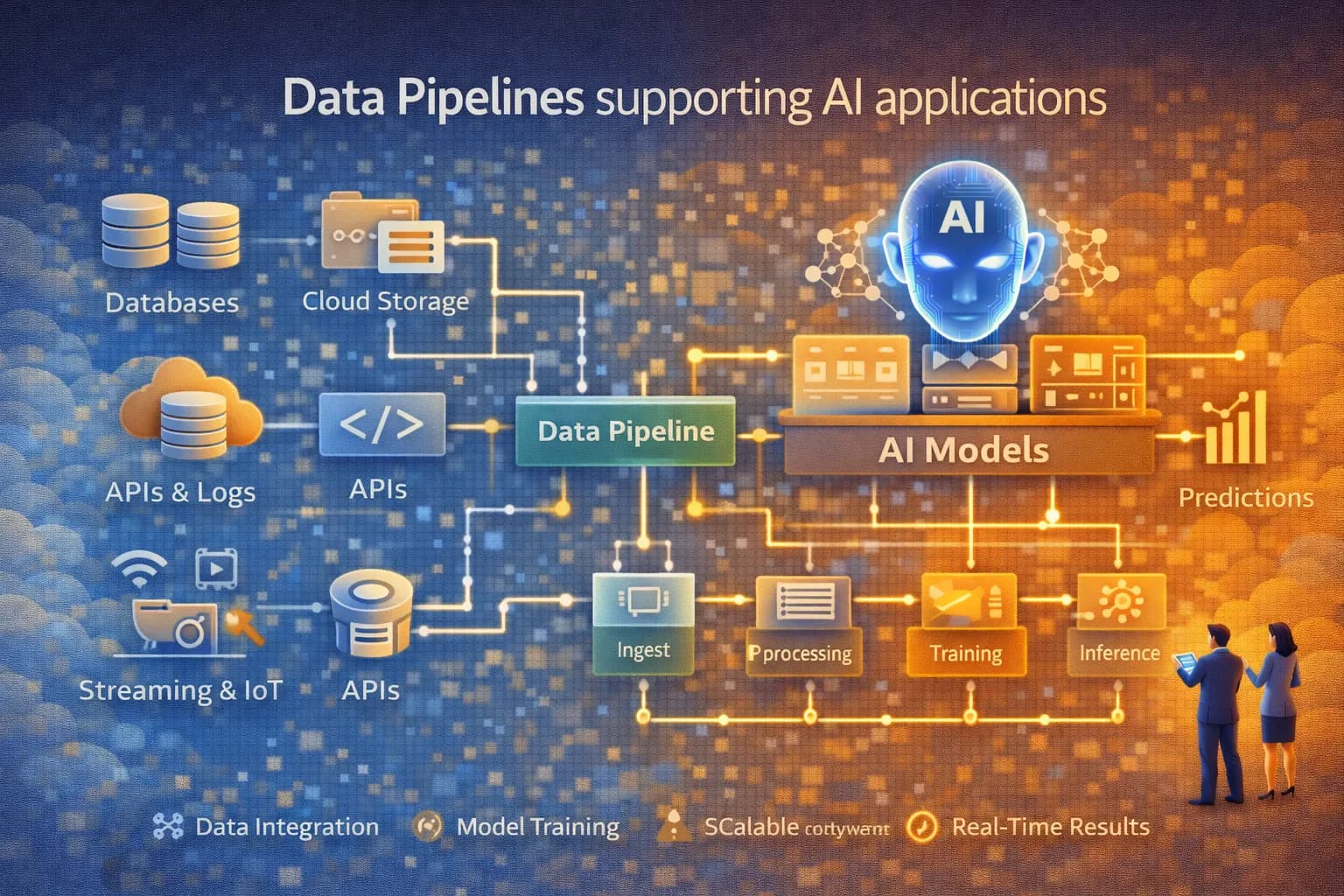
Building Data Pipelines for AI Applications
Md Sharif Foysal Shoron
Author
Data pipelines form the backbone of every successful AI application. While machine learning models often receive the most attention, their performance and reliability depend entirely on the quality and consistency of data flowing into them. Poorly designed pipelines lead to inaccurate predictions, unstable systems, and loss of trust in AI solutions.
Building robust data pipelines requires careful planning, scalable architecture, and continuous monitoring. For AI applications, pipelines must support data ingestion, transformation, storage, and delivery at scale while maintaining security and compliance.
What Is a Data Pipeline in AI Systems
A data pipeline is a sequence of processes that move data from sources to destinations where it can be analyzed or used by AI models. These sources may include applications, sensors, user interactions, and third-party services.
In AI systems, pipelines ensure that data arrives in a clean, structured, and timely manner so models can generate accurate results.
Key Components of AI Data Pipelines
Data Ingestion
Data ingestion collects raw data from multiple sources. This step must handle varying formats, volumes, and update frequencies.
Data Validation and Cleaning
Validation removes errors, duplicates, and inconsistencies. Clean data improves model accuracy and prevents unexpected behavior.
Data Transformation
Raw data is transformed into structured formats suitable for analysis and model training. This includes normalization, aggregation, and feature engineering.
Batch Processing vs Real-Time Pipelines
Some AI applications rely on batch processing, where data is collected and processed at intervals. Others require real-time pipelines that deliver immediate insights.
Choosing the right approach depends on use cases such as fraud detection, recommendations, or reporting.
Backend Architecture for Data Pipelines
Backend systems manage pipeline orchestration, storage, and access control. Frameworks like Django support secure APIs, background tasks, and integration with data processing tools.
Ensuring Data Security and Compliance
AI pipelines often handle sensitive data. Encryption, access control, and audit logging protect data throughout its lifecycle.
Monitoring and Reliability
Monitoring pipelines ensures data freshness, completeness, and accuracy. Alerts help teams respond quickly to failures or delays.
Supporting Continuous Improvement
AI pipelines must evolve as models and business needs change. Modular design allows pipelines to adapt without disruption.
How Square Tech IT Builds AI Data Pipelines
At Square Tech IT, we design data pipelines that support reliable AI applications at scale. Our solutions ensure data flows securely, efficiently, and consistently to power intelligent systems.