
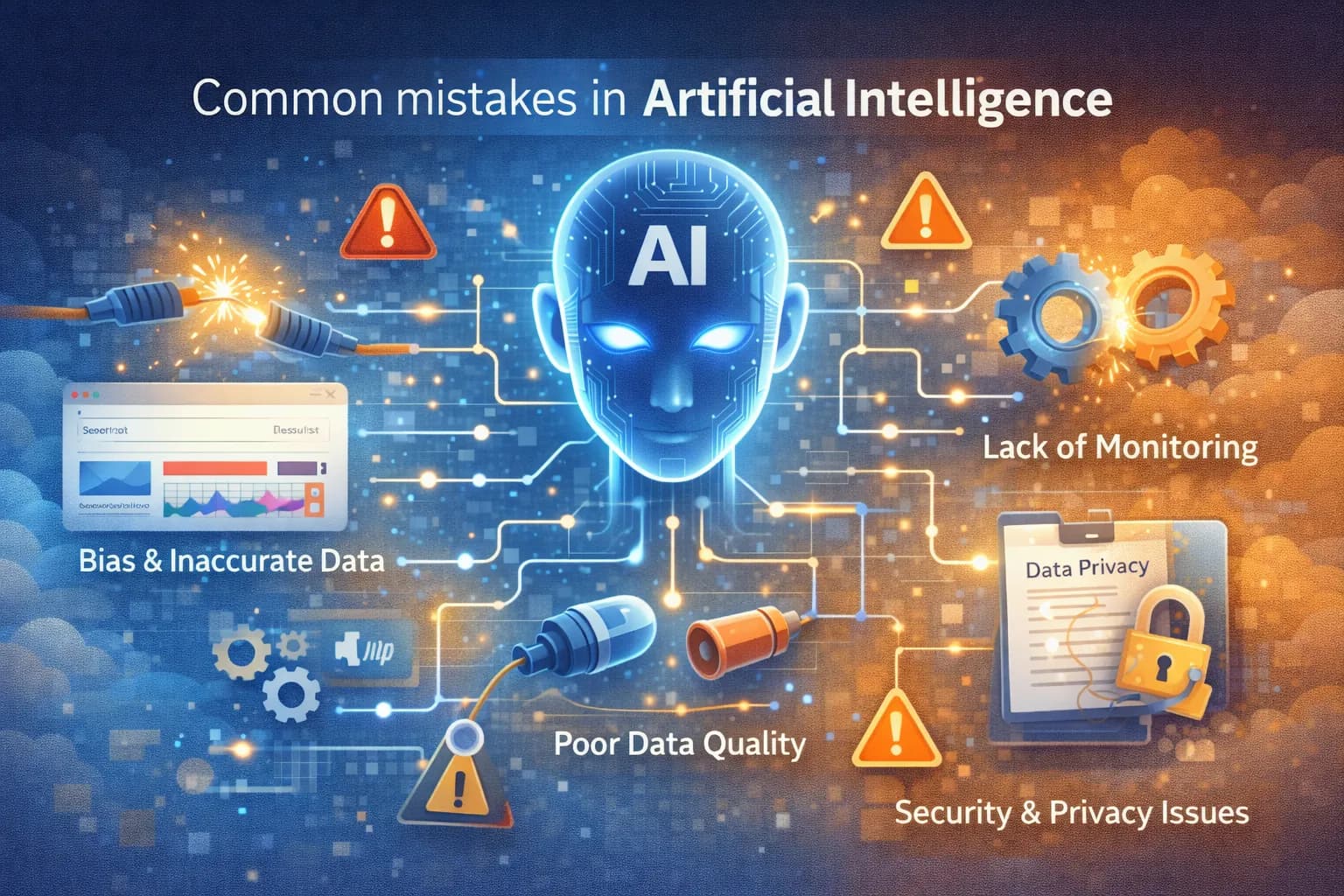
Common AI Implementation Mistakes Businesses Make
Md Sharif Foysal Shoron
Author
Artificial intelligence offers powerful capabilities, but many businesses fail to realize its potential due to poor implementation decisions. AI projects rarely fail because the technology does not work. Instead, failures usually stem from unclear goals, weak data foundations, and unrealistic expectations.
Understanding common AI implementation mistakes helps organizations avoid wasted investment, operational instability, and disappointing results. Successful AI adoption requires strategic planning, disciplined execution, and long-term commitment.
Lack of Clear Business Objectives
One of the most common mistakes businesses make is adopting AI without a clearly defined problem to solve. AI should always support a specific business goal such as improving efficiency, reducing costs, or enhancing customer experience.
When objectives are vague, AI projects often expand in scope without delivering measurable value. This leads to confusion, misaligned expectations, and difficulty evaluating success.
Poor Data Quality and Preparation
AI systems depend entirely on data. Many organizations underestimate the effort required to collect, clean, and structure data properly before training models.
Incomplete datasets, inconsistent labeling, and outdated information result in inaccurate predictions and unreliable outputs. Without strong data foundations, even advanced AI models will fail.
Overestimating AI Capabilities
Another frequent mistake is expecting AI to solve problems beyond its capabilities. AI excels at pattern recognition and prediction but struggles with ambiguous objectives and poorly defined use cases.
Treating AI as a replacement for human judgment often leads to frustration. AI should support decision-making, not replace it entirely.
Ignoring Maintenance and Monitoring
AI systems require continuous monitoring and maintenance. As data patterns change, models experience performance degradation, a problem known as model drift.
Without retraining and evaluation, AI systems slowly become inaccurate. Businesses must plan for long-term upkeep rather than treating AI as a one-time implementation.
Weak Integration with Existing Systems
AI solutions often fail when they operate in isolation. Poor integration with existing dashboards, APIs, and workflows limits their usefulness and adoption.
AI delivers the most value when insights can be acted upon immediately within operational systems.
How to Avoid These AI Implementation Mistakes
Successful AI adoption starts with clear objectives, strong data foundations, realistic expectations, and proper system integration. Businesses should begin with small, measurable use cases and scale gradually.
At Square Tech IT, we help organizations avoid common AI pitfalls by aligning AI initiatives with business strategy, building reliable architectures, and ensuring long-term stability and measurable outcomes.