
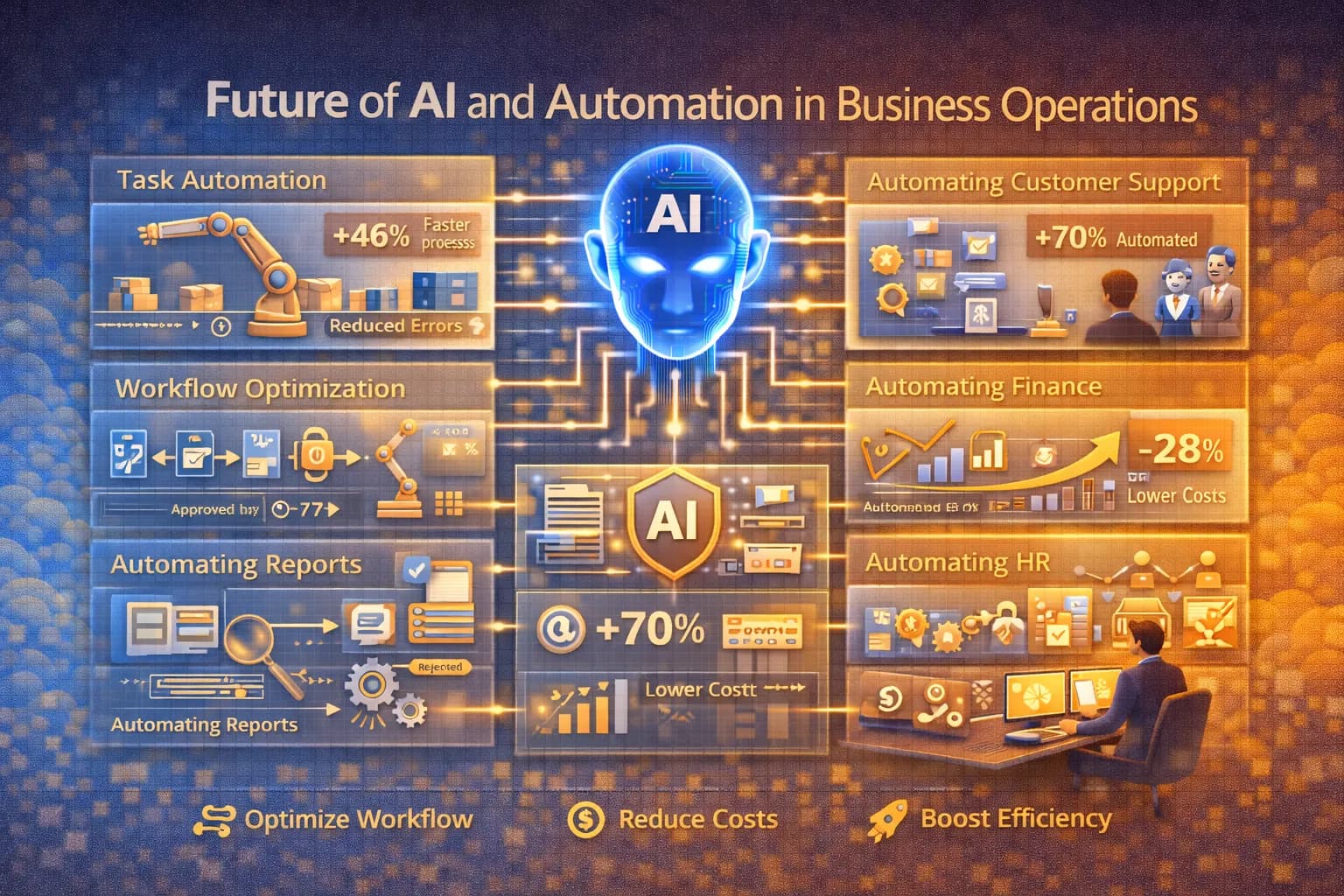
The Future of AI and Automation in Business Operations
Md Sharif Foysal Shoron
Author
Artificial intelligence and automation are no longer emerging technologies reserved for innovation labs or experimental projects. They have become foundational components of modern business operations. From internal workflows and customer interactions to decision-making and strategic planning, AI and automation are reshaping how organizations function at every level.
As businesses face increasing competition, growing data volumes, and rising customer expectations, traditional operating models struggle to scale efficiently. The future of business operations depends on intelligent systems that can adapt, learn, and operate continuously without excessive manual intervention. AI and automation together provide this capability.
How Business Operations Are Evolving
Historically, business operations relied heavily on human effort, manual coordination, and rigid processes. While early automation improved efficiency by handling repetitive tasks, it lacked flexibility and decision-making capabilities.
Today’s operations are data-driven and interconnected. Systems generate vast amounts of information across departments, platforms, and customer touchpoints. Managing this complexity manually is no longer sustainable, which is why intelligent automation is becoming essential.
The Convergence of AI and Automation
Automation and AI serve different but complementary roles. Automation executes tasks efficiently, while AI provides intelligence, learning, and adaptability. The future lies in their convergence.
In intelligent operational systems, AI analyzes data, identifies patterns, and makes decisions. Automation then executes those decisions at scale. This combination enables end-to-end process optimization rather than isolated task automation.
Smarter Decision-Making at Scale
One of the most significant impacts of AI in business operations is improved decision-making. AI systems analyze historical and real-time data to generate insights that support operational choices.
Instead of relying on intuition or delayed reports, businesses gain access to predictive insights that guide actions immediately. This enables faster responses to changes in demand, risk, or performance.
Autonomous and Self-Optimizing Processes
The future of automation goes beyond predefined workflows. AI enables processes that continuously optimize themselves based on outcomes and feedback.
For example, supply chain systems adjust ordering and distribution automatically as conditions change. Customer support workflows route issues dynamically based on urgency and complexity. These systems reduce waste, delays, and operational friction.
Operational Resilience and Risk Management
AI-driven operations improve resilience by identifying risks before they escalate. Anomaly detection systems monitor processes continuously, flagging unusual behavior that may indicate failures or security threats.
This proactive approach allows organizations to respond early rather than reacting after disruptions occur. As uncertainty increases globally, operational resilience becomes a critical competitive advantage.
Workforce Transformation, Not Replacement
A common concern around AI and automation is job displacement. In reality, the future of business operations involves workforce transformation rather than elimination.
AI handles repetitive, data-intensive tasks, allowing employees to focus on strategy, creativity, and complex problem-solving. New roles emerge around system oversight, optimization, and governance.
Backend Architecture as the Foundation
Intelligent operations require strong backend systems. AI and automation depend on reliable data pipelines, secure APIs, and scalable infrastructure.
Backend frameworks like Django play a vital role by managing data validation, access control, background processing, and system integration. Without solid architecture, AI initiatives fail to scale.
Governance, Ethics, and Trust
As AI becomes deeply embedded in operations, governance becomes essential. Businesses must ensure transparency, accountability, and ethical decision-making.
Responsible AI practices build trust with customers, employees, and regulators. Systems must be auditable, explainable, and aligned with organizational values.
Preparing for an AI-Driven Operational Future
Organizations preparing for the future should focus on building strong data foundations, modernizing backend systems, and identifying high-impact automation opportunities.
Rather than attempting large-scale transformation overnight, successful businesses adopt AI incrementally, starting with measurable use cases and expanding over time.
The Long-Term Competitive Advantage
Businesses that embrace AI and automation gain lasting advantages. They operate more efficiently, respond faster to change, and scale without proportional increases in cost.
Over time, intelligent operations become a strategic asset rather than a technical feature. Companies that delay adoption risk falling behind more adaptive competitors.
How Square Tech IT Helps Businesses Prepare for the Future
At Square Tech IT, we design AI-powered automation systems that support the future of business operations. Our approach combines scalable backend architecture, intelligent workflows, and responsible AI practices.
We help organizations transition from manual processes to intelligent operations that are efficient, resilient, and ready for growth. By focusing on real-world business needs rather than hype, we ensure AI delivers lasting value.
The future of business operations is intelligent, automated, and data-driven. Organizations that invest today will define the standards of tomorrow.