
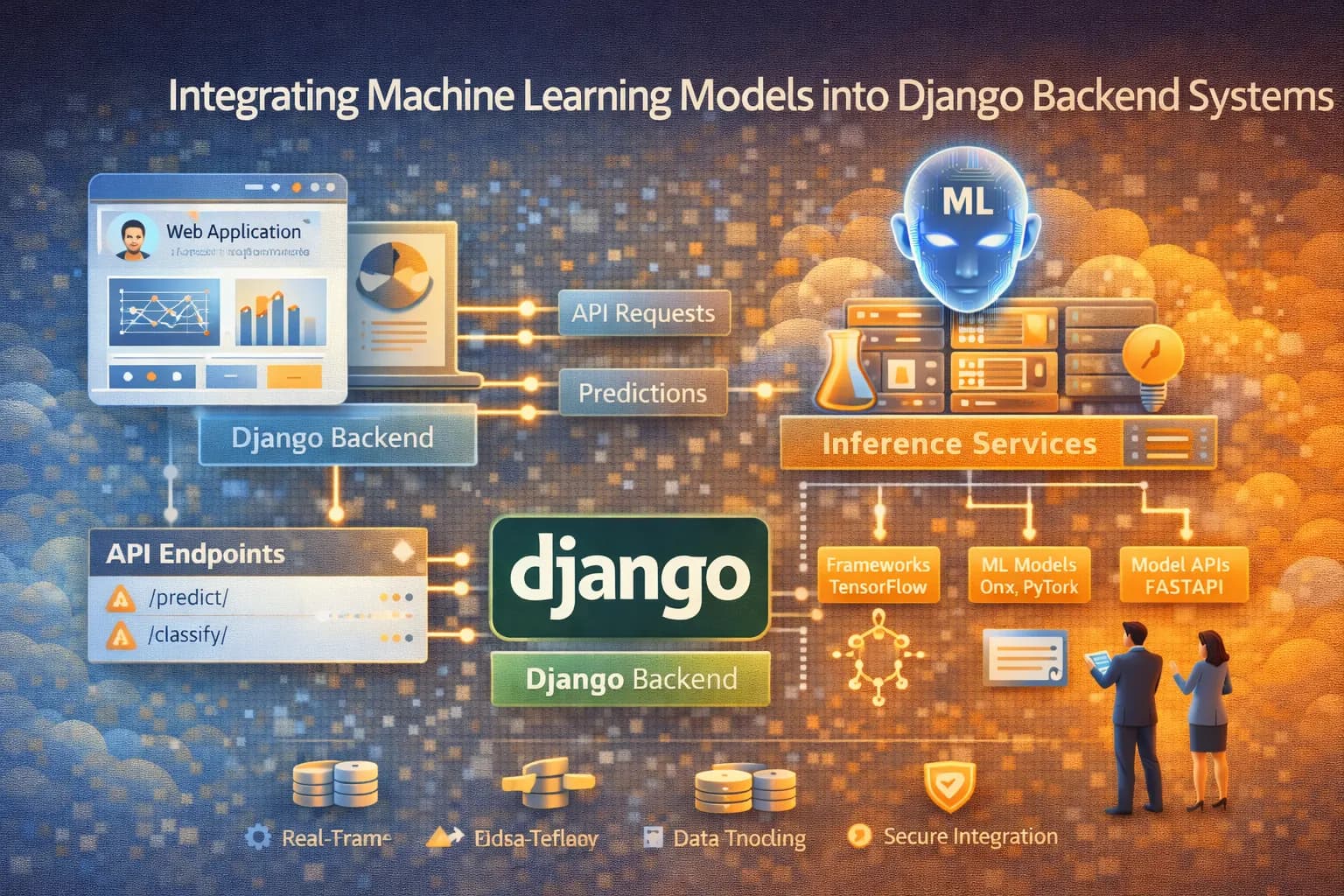
Integrating Machine Learning Models into Django Systems
Md Sharif Foysal Shoron
Author
As artificial intelligence becomes a practical component of modern applications, many businesses seek to integrate machine learning models into their existing backend systems. Django, with its strong architecture, security features, and scalability, provides an excellent foundation for deploying AI-powered functionality. However, integrating machine learning into Django systems requires careful planning to avoid performance issues, tight coupling, and long-term maintenance challenges.
Machine learning models are fundamentally different from traditional business logic. They introduce computational complexity, dependency management, and continuous improvement cycles that must be handled thoughtfully. Successful integration ensures that AI features enhance the system without compromising reliability or user experience.
Understanding the Role of Machine Learning in Django Applications
Machine learning models are typically used to support decision-making, prediction, classification, or personalization. In Django systems, these capabilities are often exposed through APIs, admin dashboards, or background processing tasks.
Rather than embedding AI logic directly into request-response flows, well-designed systems treat machine learning as a supporting service that integrates cleanly with the core application.
Choosing the Right Integration Approach
There are several ways to integrate machine learning models into Django applications, and the best approach depends on scale, performance requirements, and operational complexity.
Embedded Model Inference
In smaller systems, models can be loaded directly within the Django application. This approach simplifies deployment but may increase memory usage and response times.
External Inference Services
Larger systems often deploy machine learning models as separate services accessed via APIs. This decouples AI workloads from the Django application and improves scalability.
API Design for Machine Learning Integration
APIs serve as the primary interface between Django systems and machine learning models. Clean, well-documented endpoints ensure predictable behavior and secure access.
Django REST Framework provides authentication, permission control, validation, and rate limiting that protect AI endpoints from misuse.
Handling Performance and Latency
Machine learning inference can be computationally expensive. Performing inference synchronously during user requests can degrade performance if not optimized.
Techniques such as caching predictions, asynchronous processing, and batch inference help maintain responsiveness while delivering AI functionality.
Managing Dependencies and Model Versions
Machine learning models rely on specific libraries and dependencies that may differ from the main application stack. Isolating models in dedicated environments prevents dependency conflicts.
Versioning models ensures that updates can be rolled out safely without disrupting existing functionality.
Data Flow and Validation
Django systems play a critical role in validating and preparing data before it reaches machine learning models. Clean, structured input improves model accuracy and stability.
Server-side validation ensures that AI systems are protected from malformed or malicious inputs.
Monitoring Model Performance
Once deployed, machine learning models must be monitored continuously. Accuracy, latency, and error rates provide insight into system health.
Logging predictions and outcomes enables teams to identify model drift and retrain models when necessary.
Security and Access Control
AI endpoints often expose sensitive decision logic and data. Strong authentication, authorization, and audit logging are essential to protect these systems.
Long-Term Maintainability
Successful AI integration prioritizes maintainability. Clear separation of concerns, modular design, and documentation ensure systems remain adaptable as requirements evolve.
How Square Tech IT Integrates AI into Django Systems
At Square Tech IT, we integrate machine learning into Django systems with a focus on performance, security, and long-term stability. Our approach ensures AI features enhance real-world applications without introducing unnecessary complexity.