Monitoring, Maintaining, and Improving AI Systems Over Time
Md Sharif Foysal Shoron
Author
Deploying an AI system is not the end of the journey. In many ways, it is only the beginning. Unlike traditional software, AI systems evolve in response to data, usage patterns, and external conditions. Without ongoing monitoring and maintenance, even well-designed AI solutions can degrade over time.
Businesses that treat AI as a one-time implementation often experience declining accuracy, reduced trust, and unexpected failures. Long-term success requires continuous evaluation, improvement, and alignment with business objectives.
Why AI Systems Degrade Over Time
AI models learn from historical data. As real-world conditions change, the patterns captured during training may no longer reflect current reality. This phenomenon is known as model drift.
Changes in user behavior, market conditions, or data sources can all impact model performance. Without detection mechanisms, these changes remain invisible until failures occur.
Monitoring AI Performance Metrics
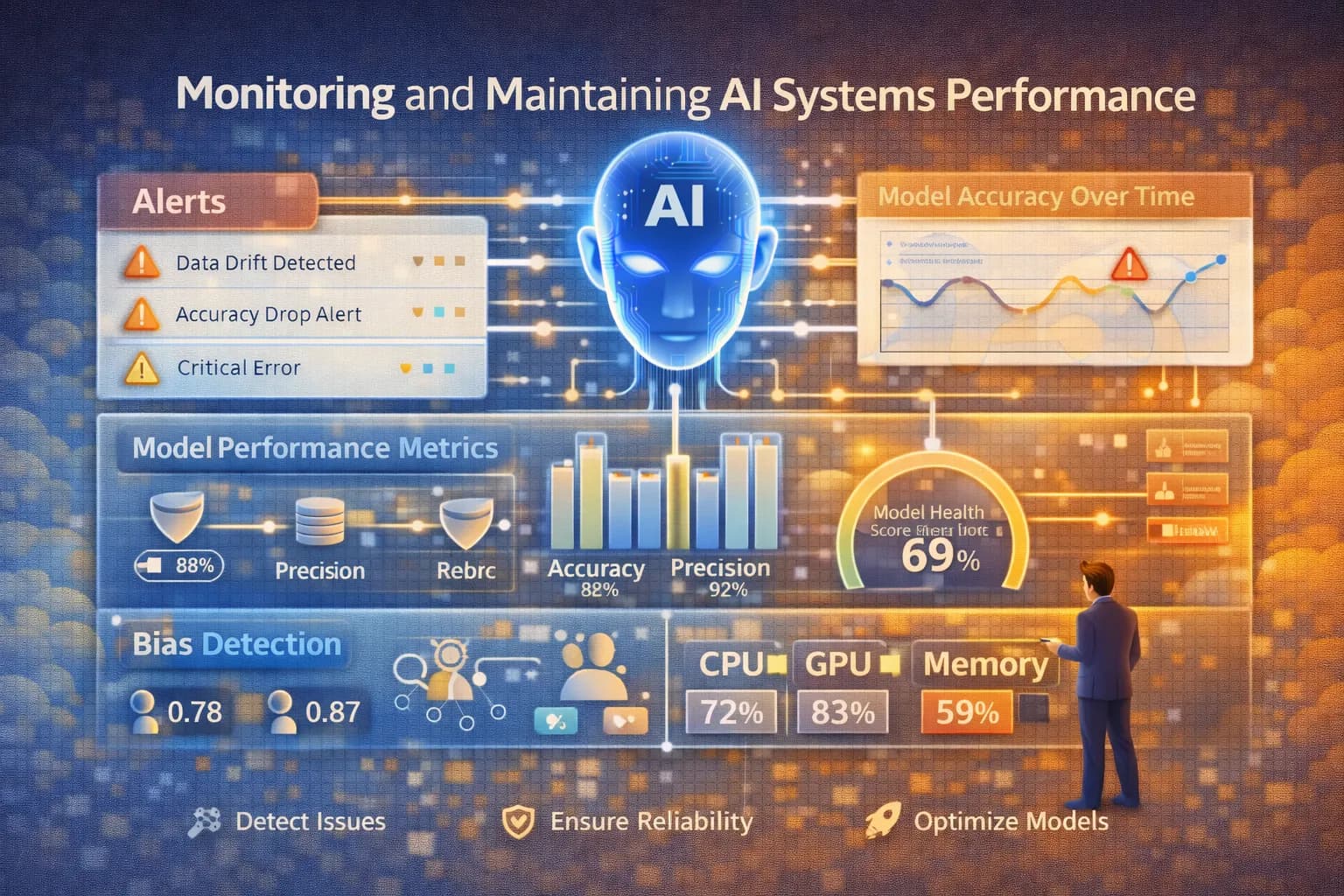
Monitoring involves tracking metrics such as accuracy, latency, error rates, and confidence scores. These indicators provide insight into system health and reliability.
Performance monitoring should be automated and integrated into operational dashboards to ensure timely response.
Detecting Model Drift and Data Issues
Drift detection compares current model behavior against historical benchmarks. Sudden changes may indicate data quality issues or shifts in user behavior.
Early detection allows teams to retrain models before errors impact users or business decisions.
Retraining and Model Versioning
Retraining models with updated data ensures continued relevance. Versioning allows teams to compare performance and roll back changes if needed.
Controlled deployment strategies reduce risk while enabling continuous improvement.
Feedback Loops and Human Review
Human feedback plays a critical role in improving AI systems. User corrections, overrides, and reviews provide valuable signals for refinement.
Combining automated monitoring with human insight results in more resilient systems.
Operational Reliability and Incident Response
AI systems must be treated as production infrastructure. Clear incident response plans ensure failures are handled quickly and transparently.
Aligning AI Performance with Business Goals
Monitoring should focus not only on technical metrics but also on business outcomes. AI systems must continue delivering measurable value.
How Square Tech IT Maintains AI Systems
At Square Tech IT, we treat AI as a living system. Our monitoring, maintenance, and improvement processes ensure AI solutions remain accurate, reliable, and aligned with evolving business needs over time.