
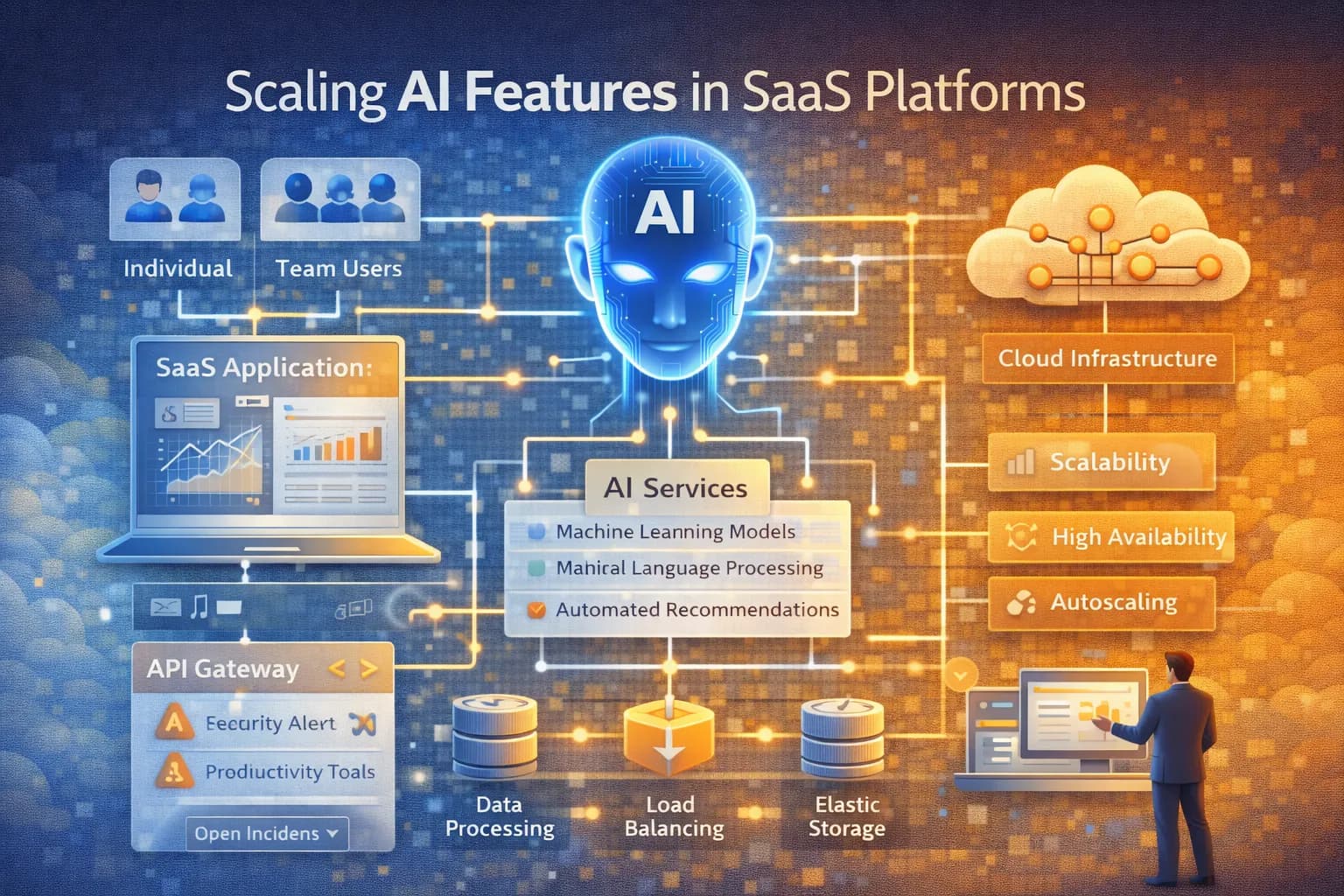
Scaling AI Features in SaaS Platforms
Md Sharif Foysal Shoron
Author
As SaaS platforms mature, AI features often move from experimental additions to core product capabilities. Early AI implementations may work well with limited users and data, but scaling these features introduces new technical and operational challenges. Without careful planning, AI systems can quickly become performance bottlenecks, cost drivers, or sources of instability.
Scaling AI in SaaS platforms requires more than increasing infrastructure capacity. It involves architectural decisions, data management strategies, monitoring systems, and thoughtful integration with existing workflows. When done correctly, scalable AI features become long-term competitive advantages rather than ongoing maintenance burdens.
Why Scaling AI Is Different from Scaling Traditional Features
Unlike traditional application logic, AI features depend on data pipelines, model inference, and sometimes real-time processing. These components introduce variability in latency, resource usage, and system behavior.
As user activity grows, AI models must handle higher request volumes while maintaining accuracy and responsiveness. This makes scaling AI more complex than scaling static application features.
Designing AI Features with Scalability in Mind
Scalability should be considered from the first AI feature implementation. Models, APIs, and data pipelines should be designed to evolve independently without disrupting the core SaaS platform.
Separating AI inference services from the main application backend allows teams to scale AI workloads independently based on demand.
Managing Data Growth and Model Performance
As SaaS platforms grow, data volume increases rapidly. AI models must be trained and evaluated on larger datasets while maintaining performance and accuracy.
Regular retraining and validation help prevent model degradation caused by changing user behavior or evolving data patterns.
Performance Optimization for AI Features
AI inference can be resource-intensive. Techniques such as caching predictions, batch processing, and asynchronous execution help maintain system responsiveness.
Backend frameworks like Django support scalable API design, background tasks, and integration with distributed systems that handle AI workloads efficiently.
Monitoring, Reliability, and Error Handling
Scalable AI systems require continuous monitoring. Performance metrics, error rates, and prediction quality must be tracked to ensure reliability.
Alerting and fallback mechanisms prevent AI failures from impacting the overall user experience.
Cost Control and Resource Management
AI workloads can significantly increase infrastructure costs if not managed carefully. Autoscaling, usage limits, and efficient model selection help control expenses.
How Square Tech IT Scales AI in SaaS Platforms
At Square Tech IT, we design AI features with scalability as a core requirement. Our SaaS solutions balance performance, reliability, and cost efficiency, ensuring AI capabilities grow smoothly alongside the business.