
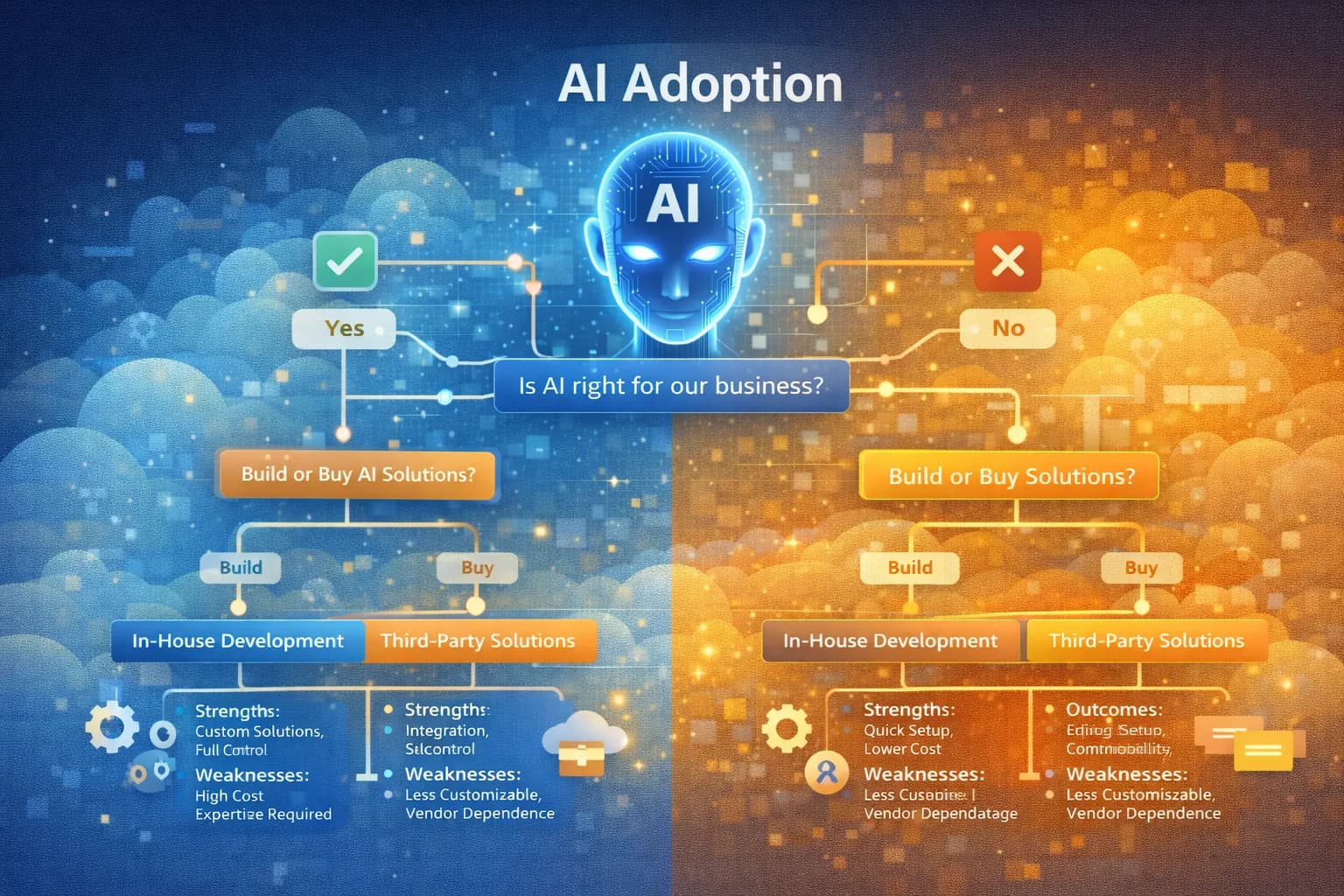
When Businesses Should Use AI (And When They Shouldn’t)
Md Sharif Foysal Shoron
Author
Artificial intelligence is often promoted as a solution to every business problem. In reality, AI is most effective when applied thoughtfully and for the right reasons. While AI can deliver powerful results, it is not a universal fix and should not be adopted simply because it is trending.
Using AI unnecessarily can increase system complexity, development costs, and operational risk without delivering meaningful value. Businesses that rush into AI adoption without clear objectives often struggle with maintenance challenges, unreliable outputs, and disappointing returns on investment.
Understanding when AI makes sense and when it does not is critical for building stable, efficient, and scalable systems. The right decision depends on data availability, business goals, and the nature of the problem being solved.
When AI Makes Sense
AI is most effective in scenarios where traditional rule-based systems fall short. These situations typically involve complexity, variability, and the need to learn from data rather than follow fixed instructions.
Large Volumes of Data
AI excels when large datasets are available and meaningful patterns are difficult or impossible to identify manually. When data volume grows beyond what human analysis or simple automation can handle, AI becomes a powerful tool.
Examples include analyzing customer behavior across thousands of interactions, detecting anomalies in financial transactions, or identifying trends in operational data. In these cases, AI models can uncover insights that drive smarter decision-making.
Predictive or Adaptive Systems
AI is well suited for systems that need to adapt over time or make predictions based on historical data. Unlike automation, AI can adjust its behavior as new information becomes available.
Common examples include demand forecasting, recommendation engines, fraud detection, and predictive maintenance systems. These use cases benefit from AI’s ability to learn and improve continuously.
When AI Is Not the Right Choice
AI is not always the best solution, especially for simple or well-defined processes. In many cases, traditional automation delivers faster, cheaper, and more reliable results.
Rule-based workflows, such as billing, reporting, notifications, and data synchronization, rarely require AI. Introducing AI into these scenarios often increases complexity without improving outcomes.
Limited Data Availability
Without sufficient, high-quality data, AI systems cannot perform reliably. Poor data quality leads to inaccurate predictions, biased results, and unstable behavior.
Businesses with limited historical data or inconsistent data collection should focus on improving data foundations before considering AI. In such cases, automation or rule-based systems are often more effective.
Cost and Maintenance Considerations
AI systems require ongoing monitoring, retraining, and infrastructure support. Models must be updated as data changes, and performance must be continuously evaluated to prevent degradation.
These long-term costs should be considered during planning. AI is not a one-time implementation but an ongoing commitment. Businesses must be prepared to invest in maintenance, data management, and system monitoring.
Making Smart AI Decisions
Making the right decision about AI adoption requires a clear understanding of business goals, system requirements, and available resources. AI should solve a real problem, not create a new one.
At Square Tech IT, we help businesses evaluate whether AI is the right tool or if simpler solutions such as automation or rule-based systems provide better results. Our approach focuses on practical value, long-term stability, and scalable architecture rather than unnecessary complexity.
By choosing AI only where it adds measurable value, businesses can build smarter systems that remain reliable, maintainable, and cost-effective over time.